

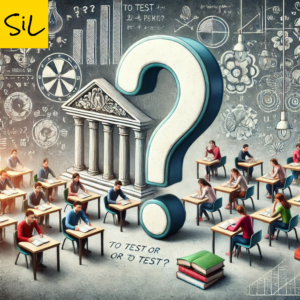
To Test or Not to Test?!
📢 The Debate on Testing: A Flawed Measure or a Valuable Tool? 🎓📖
(posted on 4th Feb 2025)
The role of testing in education has long been a topic of debate. Some argue that standardized tests create unnecessary pressure and fail to capture a student’s true abilities. Others see them as a valuable benchmark, offering insights into student progress and guiding future learning.
So, where do we draw the line? 🤔
While no test is perfect, a well-designed assessment can do more than just rank students—it can provide a meaningful reflection of their strengths, areas for improvement, and learning progress. The key lies in HOW the test is structured and WHAT it aims to achieve.
At SiL Testing System, we believe that an effective language assessment should:
✔ Go beyond rote memorization – Assess real-world language application, not just textbook definitions.
✔ Provide constructive feedback – Offer more than just a score; give students and educators clear insights on their proficiency.
✔ Ensure fairness and accuracy – Be carefully crafted, aligned with international education standards, and hand-marked by experts for precision.
Our test is not just an evaluation—it’s a tool for reflection, progress, and excellence. By providing detailed performance reports, we help students and schools understand language development in a structured yet insightful way.
What are your thoughts on the role of testing in education? Should assessments evolve, or do they still hold value in their current form? Feel free to share your thoughts!
How we want to make the fullest use of Formative Assessments...
📊 The Power of Consistent Formative Assessments in Enhancing Student Achievement 📈
(Posted on 8th Feb 2025)
🚀 Recent studies in the K-12 setting underscore the significant impact of formative assessments on student learning outcomes:
1️⃣A meta-analysis by Kingston and Nash (2011) revealed that formative assessments have a mean effect size of 0.20 on K-12 student achievement, indicating a positive influence on learning progress.
2️⃣Graham et al. (2015) found that formative assessments in writing yielded a weighted mean effect size of 0.61, highlighting substantial benefits in students’ writing performance.
3️⃣Lee et al. (2020) analyzed 33 studies and reported an overall mean effect size of 0.29 for formative assessments in K-12 education, further supporting their effectiveness in enhancing academic achievement. (This is applicable not just in the US, but also the rest of the world)
➡️These findings suggest that regular and well-implemented formative assessments can play a crucial role in promoting academic excellence.💡
At SiL Testing, we recognize the value of formative assessments and have integrated them into our approach to provide ongoing insights into students’ language development, by designing different types of questions that test on different skills, allowing a wider coverage of content and text types, and presenting a fuller picture with detailed analyses on the result slips as well as the school reports.
Our team truly believes that by embracing consistent formative assessments, educators can better understand student needs, tailor instruction and assignment of tasks based on students’ levels, and foster an environment conducive to continuous learning and improvement. 💪🏻💪🏻
(Image: Online Source)

How to teach/learn English as a Second Language...
🧑🏫🏫The Evolving Landscape of English Language Learning: Equipping Students for Success👨💻
(Posted on 14th Feb 2025)
As global communication becomes increasingly interconnected, English language proficiency has never been more crucial for academic and professional success. Recent trends indicate that schools worldwide are placing greater emphasis on structured, progressive English language learning, ensuring that students develop strong literacy, comprehension, and communication skills at different key stages. But how can educators and parents ensure that students receive the right support to master the language effectively?
👉🏻Empowering Schools with the Right Resources
At every key stage, students require targeted strategies to develop their English skills:
📌 Early Years & Primary – Focus on phonics, vocabulary building, and basic sentence structures, ensuring a solid foundation for reading and writing. Interactive storytelling, guided reading, and structured grammar exercises can be game-changers at this stage.
📌 Secondary & Beyond – At this stage, emphasis should shift toward critical thinking, advanced comprehension, and refined writing skills. Encouraging debates, analytical writing, and exposure to diverse literary genres can strengthen linguistic confidence and proficiency.
🔎For educators, selecting the right materials and assessments that align with students’ needs is essential. A well-structured curriculum, supplemented with progressive formative assessments, ensures that students are challenged at the appropriate level and provided with meaningful feedback to improve.
🔎Supporting English as a Second Language at Home
For parents who want to support their child’s English learning at home, consider the following:
✔️ Encourage daily reading and discussions in English – Exposure to books, articles, and even English-language media can enhance vocabulary and comprehension.
✔️ Incorporate English into daily activities – Label household objects, encourage journaling in English, or practise storytelling to reinforce learning in an engaging way.
✔️ Use technology wisely – There are excellent language-learning apps, audiobooks, and podcasts that can make language acquisition more immersive and enjoyable.
🇬🇧🇬🇧Introducing our Subject Test That Delivers Targeted Insights
To truly refine English proficiency, accurate assessment and structured feedback are key. That’s why we are excited to launch our UK-designed SiL English Subject Test 2025, offering:
✅ A rigorous, research-based assessment, drafted by a team of graduates of Oxford’s Department of Education
✅ Hand-marked results, evaluated mainly by Oxbridge students/graduates, ensuring deep, qualitative insights into a student’s strengths and areas for improvement
✅ Detailed result slips, offering valuable insights to both educators and parents, allowing for data-driven learning strategies
By equipping students, teachers, and parents with the right tools, assessments, and resources, we can build a stronger foundation for practical English usage and enhance the language proficiency as a second language learner.
🏆For schools interested in hosting the test or parents seeking to enroll their children, reach out to us today via email at: Hi@SharingisLearning.com🏆

International Testing Trend
Global Trends in Academic Testing: The Need for an International Benchmark 🌍📚
(Posted on 21st Feb 2025)
As education systems evolve, there’s a growing shift towards international academic testing to assess student performance on a global scale. Many countries are moving beyond national assessments, recognizing the value of a standardized global benchmark that provides a broader, more insightful perspective on student achievement.
🔹 Why is this shift happening?
Countries are seeking to understand how their students compare internationally—not just in raw scores but in key competencies like critical thinking, problem-solving, and application of knowledge. A global perspective helps policymakers and educators identify strengths and gaps in their systems and adopt best practices from other nations.
🔹 The Benefits of International Testing Systems
✅ Provides a comprehensive overview of student performance beyond national exams
✅ Encourages fair and standardized comparisons across different education systems
✅ Helps institutions and educators refine their teaching strategies based on global insights
✅ Prepares students for an interconnected world where global competencies matter
At SiL Testing System, we believe that a strong international testing framework empowers students, educators, and policymakers with the insights needed to drive meaningful improvements in education.
What are your thoughts on international academic testing? Do you see this trend shaping the future of education in your country?

On Parenting...
The Tiger Mum vs. The Western Approach to Testing: Striking the Right Balance
(Posted on 24th Feb 2025)
Testing has long been a battleground for parenting philosophies. On one side, the Tiger Mum approach pushes rigorous practice, high expectations, and the belief that pressure builds resilience. On the other, the Western model often emphasises holistic learning, emotional well-being, and reducing test anxiety. Both approaches have their strengths. The Tiger Mum’s method cultivates discipline and perseverance, while the Western style fosters creativity and intrinsic motivation. But can we have the best of both worlds when it comes to assessment?
A balanced approach to testing should:
✅ Encourage effort, not just results – Rote learning has its place, but understanding the why behind answers builds true mastery.
✅ Use assessment as a learning tool – Tests shouldn’t just rank students; they should provide insights for growth.
✅ Support resilience without fear – Pressure can drive success, but excessive stress can backfire. The right challenges, with the right support, create confident learners.
✅ Promote a growth mindset – Whether a child aces a test or struggles, the takeaway should be: How can I improve next time?
Testing should reflect real learning—not just memorisation, nor just self-expression, but a meaningful bridge between knowledge, application, and confidence. Here at SiL, we want to design meaningful tests that are comprehensive on a subject level and we want our tests to be able to assess the various cognitive abilities of the students, by the use of different question types and models.
How do you think we can improve the way we approach testing in schools today?

International Language Tests, what for? And why should my child/student join?
Why Should Students Take International Language Tests? 🌍📚
(Posted on 28th Feb 2025)
In today’s globalized world, mastering English is more than just a skill—it’s a gateway to opportunities. International language tests don’t just assess proficiency; they open doors to academic success, career advancement, and cultural connections.
Why take an international language test?
✅ Recognition – Gain a globally accepted certification of your English proficiency.
✅ Confidence – Validate your skills and set clear learning goals.
✅ Opportunities – Strengthen applications for universities, scholarships, and jobs.
✅ Competitive Edge – Stand out in an increasingly global workforce.
🚀 Introducing the English Subject Test 2025
Designed for Years 1-9 learners who want to demonstrate excellence in English, the SiL English Subject Test 2025 provides a comprehensive assessment that covers:
🔹 Reading & Comprehension – Analyze texts with precision.
🔹 Grammar & Vocabulary – Show mastery of language rules.
🔹 Critical Thinking – Apply language skills in real-world contexts.
A strong score on the English Subject Test 2025 not only showcases your ability but also helps you take the next step in your academic journey.
Are your students/children ready to challenge themselves through an international test & contest? 🌟
📩 Learn more and register today!